You start the computer one morning, and your documents, photos and films will not open. Every file has a new, strange name. On the desktop there is also a message that demands a ransom in bitcoin before you get your data back.
This is a ransomware attack, in other words extortion malware. It hits private individuals, sole traders and companies with many employees. That is why we at Dator Hjälp have built a complete service: we prevent attacks, stop attacks in progress and restore files and data as far as it is technically possible.
How a ransomware attack works
First, the attacker gets in. Most often this happens through a fake email, an attached invoice, a pirated program or a vulnerability that nobody has patched. Sometimes a single stolen password without two-step verification is enough.
Then the attacker waits. For days or weeks, the program looks for network drives, NAS devices, cloud folders and backups. Only when it has found everything does it strike, often on a Friday evening or during a weekend.
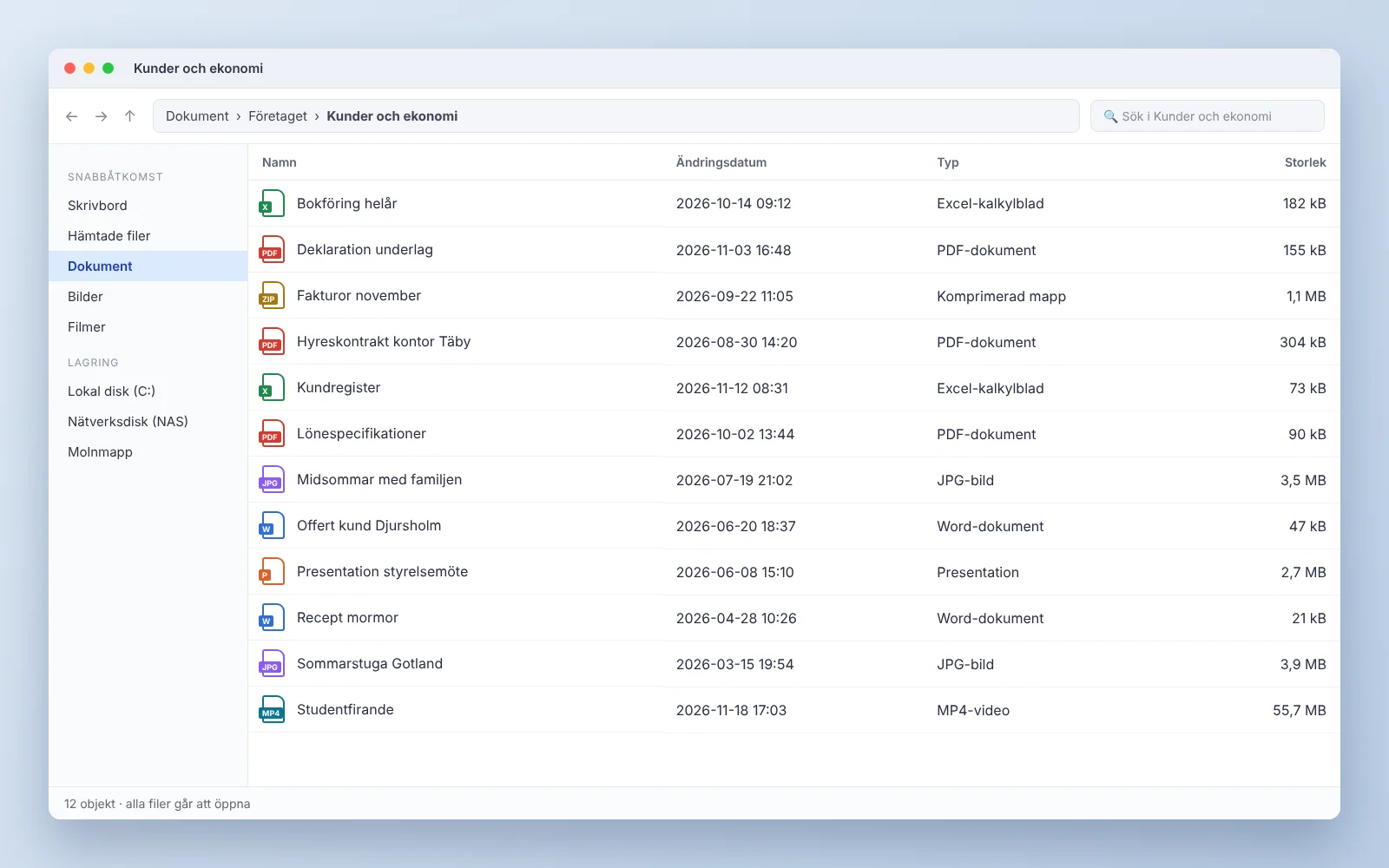
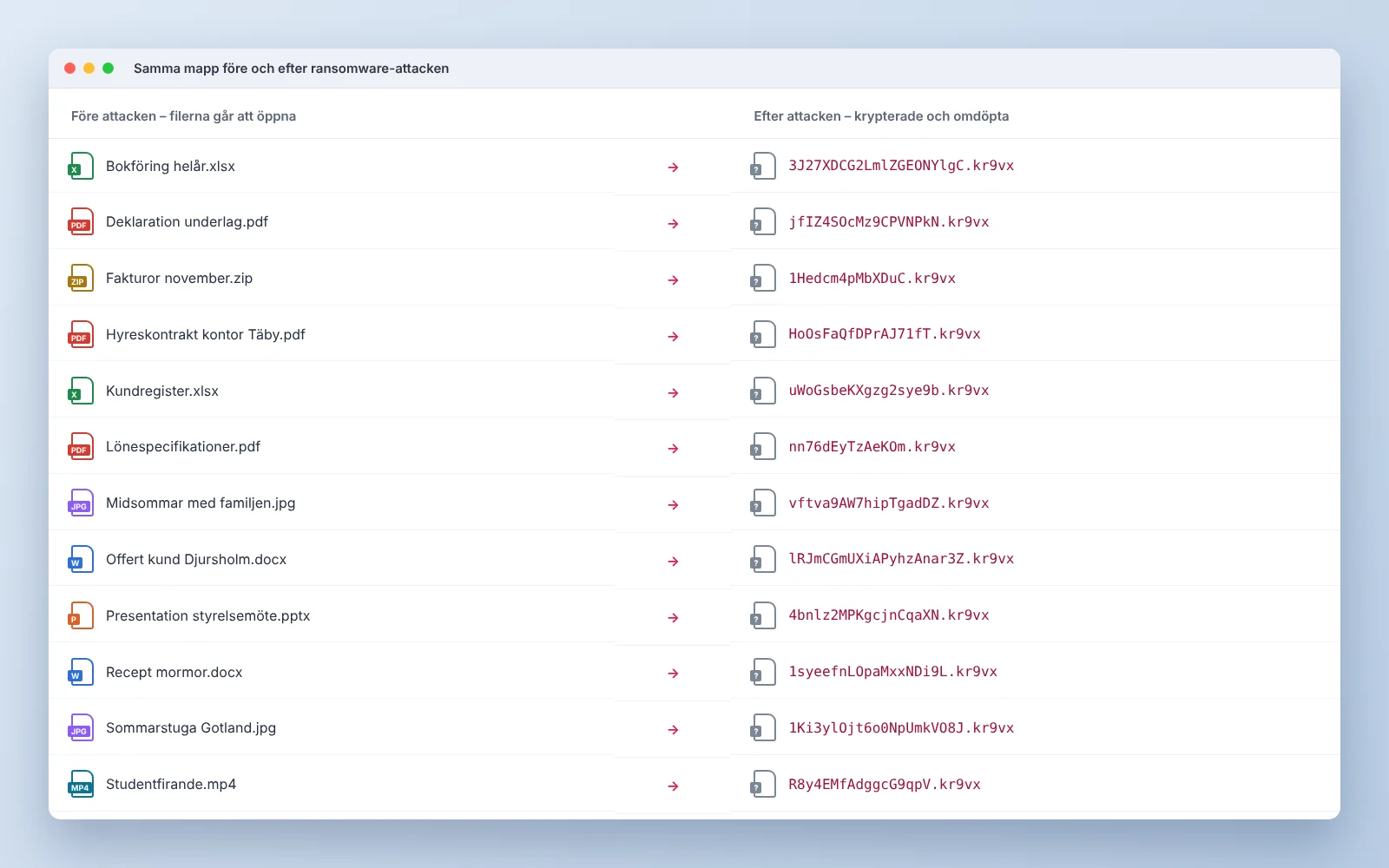
After that, the program encrypts your files and renames them, for example holiday.jpg.akira or quote.docx.locked. At the same time, it deletes the Windows shadow copies and places a note with payment instructions in every folder. Modern groups also steal data before the encryption and threaten to publish it. The industry calls this double extortion.
Ransomware attacks on Swedish organisations are rising
The threat is not theoretical. In January 2024, the Akira group encrypted servers in one of Tietoevry’s Swedish data centres, and authorities, municipalities and retail chains were left without systems for several weeks. In August 2025, a ransomware attack on the system supplier Miljödata knocked out HR systems at around 200 municipalities and regions. According to the Swedish Prosecution Authority, the attackers then published personal data about more than 1.5 million Swedes on the dark web.
According to PwC, ransomware hit 7,635 organisations worldwide in 2025, compared with 4,837 the year before. In addition, Check Point Research measured an average of 3,103 cyber attacks per week against Swedish organisations in September 2026, 73 per cent more than a year earlier. Criminal groups now rent out ready-made tools as a service. As a result, even someone without technical skills can carry out an attack on a family home, a dental practice or an accounting firm.
Prevent – plan the IT system before anything happens
We do the most important work long before an attack. An IT system that we have planned correctly from the start can withstand even sophisticated attacks. For private individuals and smaller companies, we go through the following:
- backups according to the 3-2-1 principle, with at least one copy offline or immutable that the attacker cannot delete,
- regular restore tests, because a backup that nobody has tested is not a backup,
- two-step verification for email, Microsoft 365, iCloud, Google and the bank,
- updates for Windows, macOS, routers and NAS devices,
- separate administrator accounts and ordinary user accounts for daily work,
- controlled folder access in Windows and modern protection against malicious code,
- a segmented network, so that one infected computer cannot reach every other device.
Planning makes the difference, because sophisticated groups count on you having a backup. That is why they first find and delete the copies, switch off the protection and wait until they have full permissions. An IT system without a plan is then hard to save afterwards. With a plan that we have built in advance, however, the attacker never reaches the immutable copy, and we can read your files back without anyone paying a single krona in ransom.
For companies, we also draw up a simple incident plan. It describes who does what, which systems must come back first and where you find the contact details when the computers do not work.
Stop a ransomware attack in progress
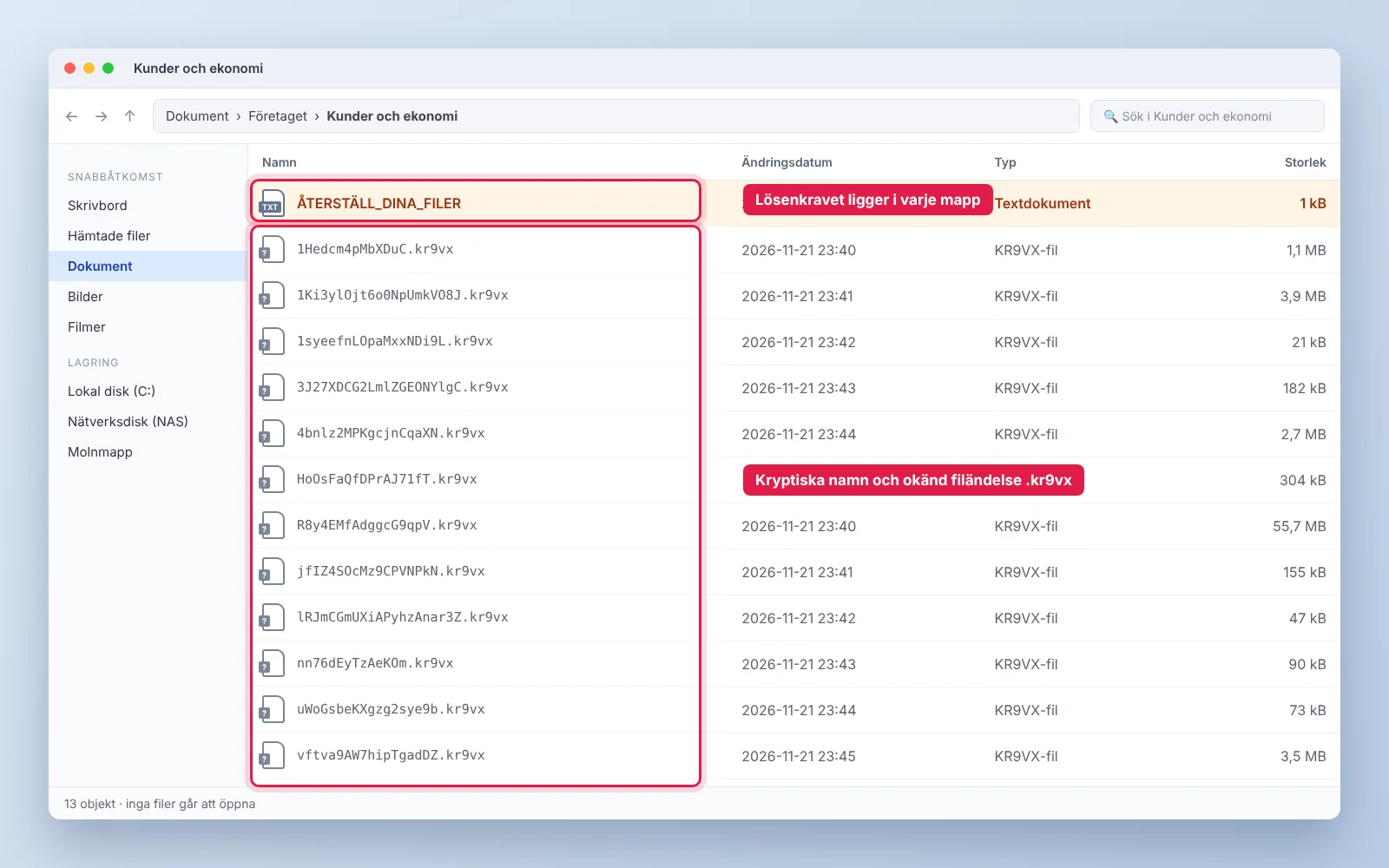
Do you notice files changing names while you watch? Then unplug the network cable and turn off Wi-Fi at once. However, do not shut down the computer before you have called us, because some traces and keys only exist in the working memory.
Do not pay the ransom. Swedish authorities advise against it, and payment gives no guarantee. Moreover, you show that you are willing to pay, which makes you a new target. Report the crime to the police instead. Companies that handle personal data may also need to report the incident to IMY, the Swedish Authority for Privacy Protection, within 72 hours.
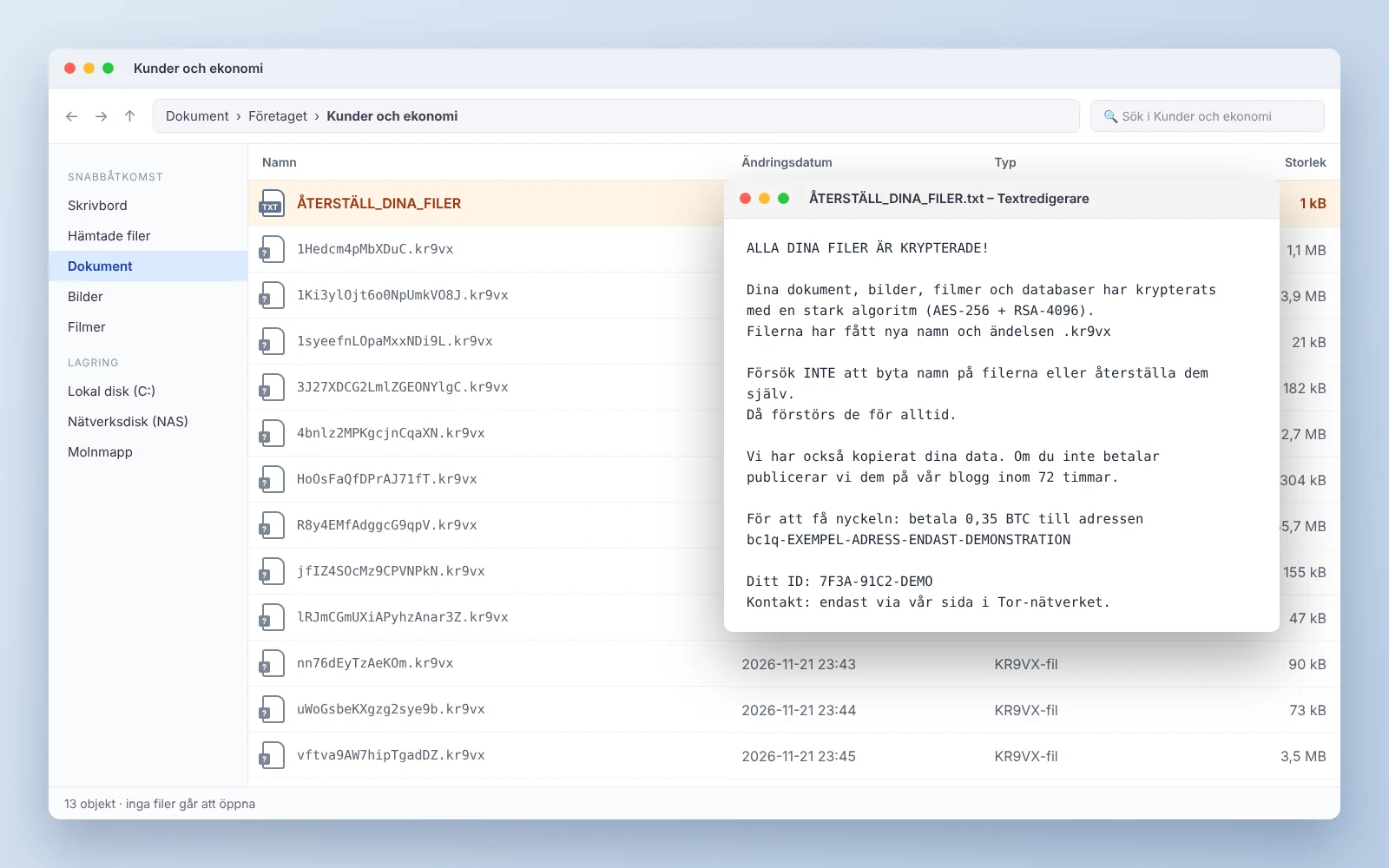
When we arrive, we isolate the infected devices, secure traces and copy the encrypted disks before we do anything else. In this way, no action destroys the chance of restoring data later.
Restore files and data after ransomware
First, we identify which ransomware family it is, based on the file extensions and the ransom note. For several older families, free decryption keys exist through the police and Europol project No More Ransom.
If no key exists, we continue along other routes. We look for remaining shadow copies, versions in OneDrive, iCloud and Google Drive, snapshots on Synology or QNAP devices, old external disks and deleted original files that the program did not manage to overwrite. It is the same technique that we use for data recovery from crashed computers. After that, we reinstall the computer from scratch and read back the cleaned material.
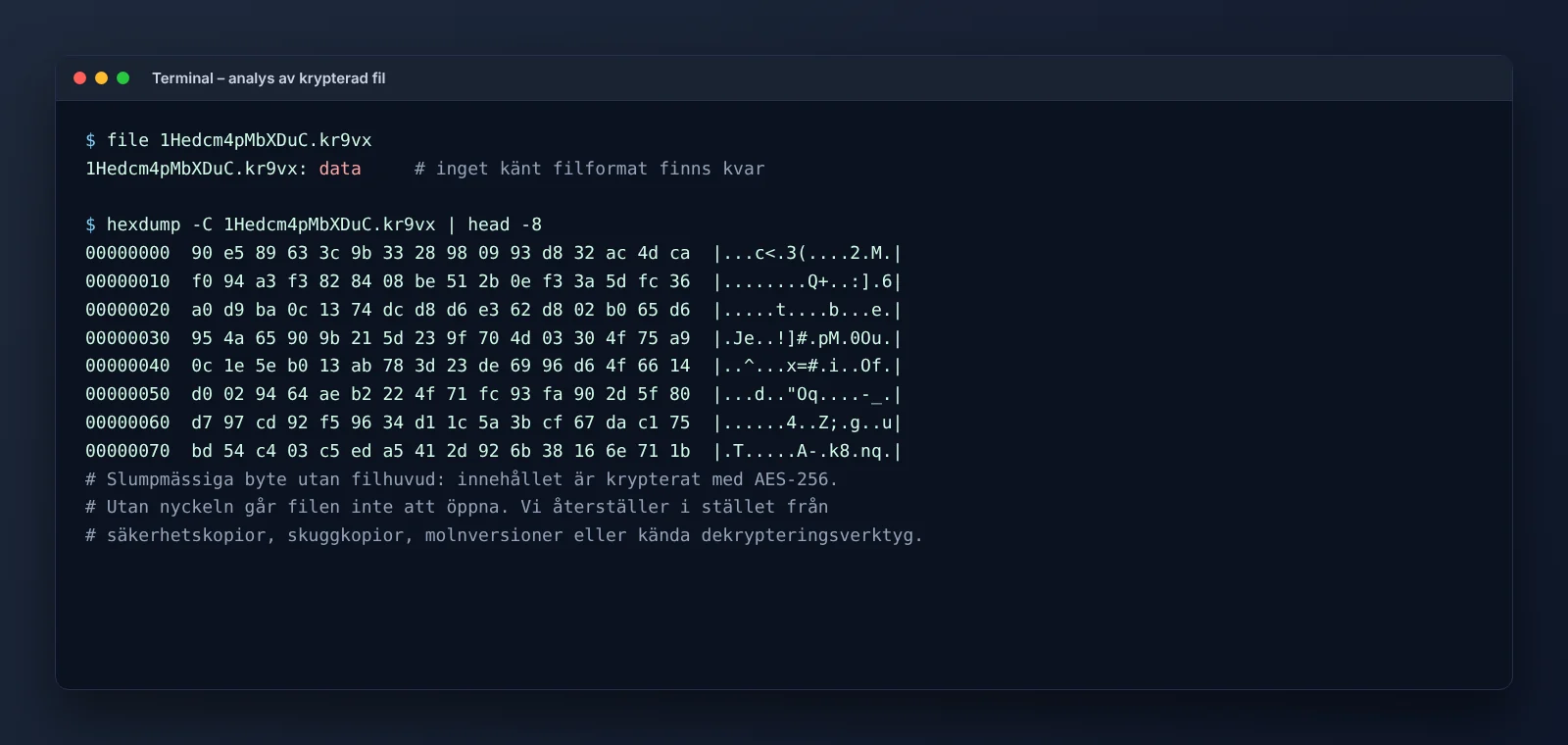
We are honest about the result: modern ransomware with strong encryption cannot be broken without the key. That is why the preparations almost always decide how much we can save. If you have a working backup, we usually have you up and running the same day.
Why choose Dator Hjälp for ransomware?
We work in three steps: we prevent the attack by planning the IT system, we stop the spread when something happens and we restore files and data afterwards. In addition, we have more than 30 years of experience of computers, networks and IT security, among other things from the defence industry and Ericsson’s development units. For example, we work with Windows, macOS, Linux, Microsoft 365 and NAS storage, and we help both private individuals at home and companies on site or remotely.
Do you want to know how well your home or your company can withstand a ransomware attack? Contact us through the form, and we will go through computers, backups and accounts. Prices from €200 per hour excluding VAT. Private individuals in Sweden pay only half the labour cost with the RUT deduction when we work on site in the home. Dator Hjälp is part of Datorkirurgen AB.
Frequently asked questions about ransomware attack
I have been hit by a ransomware attack – what do I do now?
I have been hit by ransomware, what do I do?
Unplug the network cable and turn off Wi-Fi. Leave the computer on, pay nothing and call us. We isolate the computer, secure traces and copy the disk before we start restoring.
My files have changed names, what has happened?
Extortion malware has probably encrypted the files and given them new names. The files are still there, but the content stays locked until someone restores it.
Hackers demand money to restore my files, should I pay?
No. The police and the authorities advise against it. You have no guarantee of a working key, and you show that you are willing to pay again.
All my photos have a strange file extension, can they be saved?
Often a large part can be saved. We look for copies in the cloud, on old disks, in shadow copies and among deleted original files.
The computer shows a message that my files are encrypted, is it real?
It can be a scam in the browser or a genuine attack. If your documents will not open, the attack is genuine. Contact us and we will check.
Should I turn off the computer while the attack is running?
Disconnect the network first. Then leave the computer on, because the working memory can contain traces and sometimes keys.
How quickly can you come to my home?
In an acute attack, we give you priority. We can also start remotely once the computer has a safe connection to the network.
Can I remove the virus myself and keep using the computer?
We advise against it. A clean-up can destroy the chance of restoring the files, and the attacker may have left a back door.
Get files back after a ransomware attack
Is it possible to unlock encrypted files for free?
Sometimes. For several known ransomware families, free keys exist through the No More Ransom project. We find out whether that applies to your files.
Will I get my files back if I pay the ransom?
Not necessarily. Many people pay and receive a key that does not work, or none at all. Furthermore, the attackers can come back.
Where do I find a decryption tool for my ransomware?
The No More Ransom website from the police and Europol collects the tools. The wrong tool can damage the files, however, so let us run it on a copy.
Can the version history in iCloud or OneDrive rescue my photos?
Often, yes. OneDrive and iCloud keep earlier versions for a while, so we can restore the files to their state before the attack.
How do I find out which ransomware I have?
The file extension and the ransom note usually reveal the family. We analyse both and compare them with known variants.
Does it work to simply rename the files back?
No. The name is only a sign. The content remains encrypted and needs a key or a copy.
Even the backups on my external disk are encrypted, is there any hope?
Yes, sometimes. We look for older copies, snapshots on the NAS device and original files that the virus did not manage to overwrite.
How long does it take to restore everything?
With a working backup, you are usually up and running the same day. Without a backup, the work can take several days.
Ransomware attack on the company
Our company has ransomware, who should we call first?
Call us to stop the spread, and then report the crime to the police. After that, contact the insurance company.
Do we have to report the attack to IMY?
If the attack may have affected personal data, you normally report it to IMY within 72 hours. We help you with the documentation.
The attackers threaten to publish our customer data, what do we do?
Do not pay. Report it to the police, document everything and inform the customers concerned. We investigate which data has left the network.
Our servers and our NAS device are locked, can you help us?
Yes. We isolate the devices, secure traces and restore in the right order, so that the most important systems come back first.
Will the insurance pay if the attack knocks us out?
That depends on the policy. Many cyber insurance policies require a police report and documentation, and we produce both for you.
What do we tell the customers after the attack?
Be early and factual. Explain what has happened, which data the attack may have affected and what you are doing now.
Protection against ransomware attack in the future
How do I protect myself against ransomware?
Keep a backup that the attacker cannot reach, two-step verification on every account and updated programs. We go through everything for you.
Is antivirus on the computer enough?
No. Good protection stops a lot, but backups, updates and strong sign-ins must be in place too.
What is an immutable backup?
A copy that nobody can change or delete for a certain time, not even an attacker with an administrator account.
Does ransomware also hit Mac and mobile phones?
It happens, even though Windows is the most common target. Shared folders and cloud folders can also take damage from another computer.
Which route did the virus take into the computer?
The most common routes are fake emails, stolen passwords and programs without updates. We find the route so that you can close it.
Why did the attackers choose me?
Usually they pick at random. Automated tools look for weak passwords and old programs at thousands of targets at once.
What does your help with ransomware cost?
Prices from €200 per hour excluding VAT. Private individuals in Sweden pay half the labour cost with the RUT deduction for work in the home.
Do you help both private individuals and companies?
Yes, from a single computer at home to offices with servers, NAS storage and Microsoft 365.